The status of residence called “Long-Term Resident” is given to foreigners who are allowed to live in Japan by the Minister of Justice in consideration of special circumstances or humanitarian reasons.
Unlike permanent residents, they are subject to a limited period of stay, but they face no restrictions on employment or activities and can work in various fields.
◆Long-Term Residents designated by the Ministry of Justice Notification
The Ministry of Justice’s Notification on Long-Term Residents outlines examples of people who may qualify for Long-Term Resident status.
- Individuals Recognized as Refugees and Their Families
- Third-generation persons of Japanese descent
- Spouse of the child of a Japanese national who holds the status of residence ‘Spouse or Child of Japanese National
- Spouse of a Long-Term Resident Granted a Stay of Over One Year
- Spouse of a Third-Generation Person of Japanese Descent Holding Long-Term Resident Status with a Period of Stay of More Than One Year
- Unmarried Minor Biological Child Supported by a Japanese National, Permanent Resident, or Special Permanent Resident*
- Unmarried Minor Biological Child Cared for by a Long-Term Resident Granted a Stay of Over One Year*
- Unmarried Minor Biological Child Cared for by a Third-Generation Individual of Japanese Ancestry Who Holds Long-Term Resident Status Valid for Over One Year*
- Adopted Child Under Six Cared for by a Japanese National, Permanent Resident, Long-Term Resident Granted a Stay of Over One Year, or Special Permanent Resident
- Japanese People Left Behind in China Following World War II
*It appears that the older an “unmarried minor biological child” is, the more difficult it becomes to obtain long-term resident status.
◆Cases of Long-Term Residents Outside the Ministry of Justice Notification
Long-term resident status may, in practice, be granted even to those not specified in the Ministry of Justice’s notification. The examples below illustrate cases outside the notification.
◆Foreign Spouse Remaining in Japan After Divorce or Bereavement from a Japanese National or Permanent Resident
Individuals holding the residence status of “Spouse or Child of Japanese National” or “Spouse or Child of Permanent Resident” who lose their marital relationship due to divorce or bereavement may still be permitted to remain in Japan by changing their status to “Long-Term Resident,” provided certain conditions are met.
This residence status is granted at the discretion of the Minister of Justice, based on a comprehensive assessment of factors such as the applicant’s living foundation in Japan, past residence history, and relevant social circumstances.
●Requirements for Obtaining “Long-Term Resident” Status After Divorce or Bereavement from a Japanese National or Permanent Resident
・A genuine marital relationship that has continued for approximately three years or more
It is essential that the marriage was not only formal but involved genuine cohabitation and a shared daily life.
・Continuous residence in Japan
It is required that the applicant resided in Japan during the period of marriage.
・The ability to maintain an independent livelihood
Having a stable source of income or employment is an important requirement.
Even if the applicant is currently receiving public assistance, cases may still be considered if there is a clear and realistic plan for future financial independence.
・Having a record of good behavior
It is necessary that the applicant has no history of legal violations or other misconduct.
●Cases Involving a Child of a Japanese National or Permanent Resident
If the applicant has custody of a child who is a Japanese national or permanent resident, and is actually raising the child, permission may be granted even if the duration of the marriage was less than three years.
◆Foreign Parent Caring for a Japanese Child
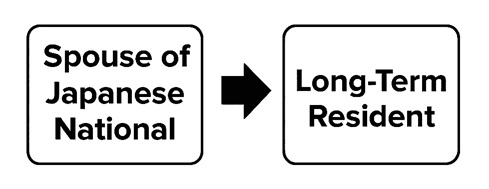
If a Japanese child is both underage and unmarried, a foreign national who is actually caring for and raising the child may be recognized as having “special circumstances” and may be eligible to obtain the status of residence of “Long-Term Resident.”
This residence status prioritizes the child’s welfare and the stability of their upbringing, and is granted at the discretion of the Minister of Justice based on individual circumstances.
●Requirements for Foreign Parents to Obtain “Long-Term Resident” Status When Caring for a Japanese Child
- The child must be born to a Japanese parent and be legally recognized as their biological child, including children born outside of marriage.
- The child must be under the age of 18 and unmarried.
- It is required that the foreign parent has legal custody of the child.
- The applicant must have continuously cared for and lived with the child for a significant period.
- The foreign parent must either have sufficient income or a concrete plan to become financially self-reliant.
- The applicant must have a record of lawful conduct and be deemed socially trustworthy.
◆People of Japanese Descent (Second Generation)
Only individuals with a biological link are eligible; adopted children are not included.
●Requirements for Second Generation Japanese Descendants to Obtain Long-Term Resident Status
- The individual must be a second-generation Japanese descendant born after the parent lost Japanese citizenship.
◆Spouse of a Second-Generation Japanese Descendant
Spouses of second- and third-generation Japanese descendants may be granted “Long-Term Resident” status if certain conditions are met.
This status is granted at the discretion of the Minister of Justice when it is determined that the applicant has both the intention and the foundation to live stably in Japan through marriage to a Japanese descendant by blood.
●Requirements for Spouses of Second- Generation Japanese Descendants to Obtain Long-Term Resident Status
- The applicant must be legally married to a Japanese descendant; common-law or de facto marriages are not accepted.
- The applicant must be cohabiting with and providing mutual support to their spouse, maintaining a marital relationship consistent with socially accepted norms.
- The couple must be capable of maintaining a stable life together, including sufficient income and secure housing.
◆Child of a Japanese Descendant (2nd Generation)
Biological children of second-generation Japanese descendants may be granted Long-Term Resident status only if certain conditions are met.
This status is granted at the discretion of the Minister of Justice when it is determined that the applicant, as a descendant by blood, has both the intention and the foundation to live stably in Japan. Please note that children adopted through legal adoption are not eligible.
- Biological child who is a minor and unmarried
- The parent is a Long-Term Resident, and the applicant is under their care and support.
◆Period of Stay for Long-Term Resident Status
In Japan, the period of stay for Long-Term Resident status is typically set at 6 months, 1 year, 3 years, or 5 years. For first-time applicants, a one-year period is most commonly granted.
If you continue to live in Japan stably and without any issues, you may be granted a longer period of stay upon each renewal. This can be seen as a sign that your life is becoming well-rooted in Japanese society.
However, please note that if you commit any acts in violation of the law, your residency status may be revoked, and you may lose the right to remain in Japan. It is also extremely important to observe your period of stay. Even overstaying by a single day may be considered illegal residence.
To avoid this, we strongly recommend that you begin the renewal process well in advance of your expiration date.
→Click Here to Learn About the Procedure for Extending Your Period of Stay
★Ask a Legal Expert Now!
The Long-Term Resident status is a somewhat special type of residency, as decisions are made based on each applicant’s individual circumstances.
For this reason, it is very important to consult thoroughly with a certified immigration specialist (Gyoseishoshi lawyer) before applying, so that you can receive advice tailored to your specific situation.
◆Applying for Permanent Resident Status
As your life in Japan becomes more established—through work, family, and connections in your community—you may begin to feel that you wish to continue living here in a stable and lasting way. If you have built a foundation for life in Japan and hope to remain here in the future, we strongly encourage you to consider applying for permanent residency once the necessary conditions are met.
→Click here for details on permanent residency applications.