
Welcome! My name is Genichi Hirayama, a certified Administrative Scrivener based in the Kamakura and Yokosuka area.
I specialize in supporting foreign nationals with visa applications and residency procedures in Japan.
Whether you're applying for a new visa, renewing your status of residence, or navigating the complexities of Japanese immigration procedures, I’m here to help you every step of the way.
◆ I offer assistance with:
- Marriage Procedures with a Foreign National or Japanese Citizen
-
If you are a Japanese citizen planning to marry a foreign national, or a foreign resident wishing to marry a Japanese citizen, I can assist you with the necessary legal procedures and documentation.
From preparing marriage registration documents to navigating immigration requirements, I offer personalized support to help make the process smooth and stress-free. Feel free to reach out for a consultation.
- Bringing Your Foreign Spouse to Japan
-
When a Japanese national wishes to invite their foreign partner living abroad to Japan, and when a foreign resident in Japan wishes to invite their partner from overseas, the required procedures differ.
Our office provides support for obtaining the appropriate residence status (commonly referred to as a visa) in each case. Please feel free to consult us.
→Click here to learn more about how to bring your foreign spouse or partner to Japan.
- Family Reunification: Bringing Your Family Members to Japan
-
Even when inviting family members to Japan, the applicable residence status (commonly referred to as a visa) differs depending on the circumstances—for example, whether the child is of a Japanese and foreign national, the child of a foreign parent, or whether the family member is a biological child or an adopted child.
Our office provides support for applications tailored to each case. Please do not hesitate to consult us.
→Click here to learn more about how to invite family members other than your spouse to Japan
- Birth of a Child
-
This guide explains the administrative procedures required when a Japanese child is born abroad or when a foreign child is born in Japan.
As these matters concern nationality, the information is important, so please take a moment to read it.
→Click here to learn more about the procedures for registering a child born in Japan or overseas.
- Changing Your Residency Status to Spouse or Child of Japanese National
-
For those who are married to a Japanese national and currently hold a different residence status, we recommend changing to the “Spouse or Child of Japanese National” status (commonly known as the Japanese spouse visa).
This visa provides greater stability for your life in Japan compared to a work visa. Please feel free to consult us.
→Click here for information on changing your status of residence (commonly known as a visa).
- Renewing Your Residency Status
-
Residence status (commonly referred to as a visa) has an expiration date. Unexpected issues may arise if procedures are delayed.
We recommend taking action well in advance. Please feel free to consult us.
→Click here for information on renewing your status of residence (commonly known as a visa).
- Applying for Permanent Residency in Japan
-
If your life in Japan has become stable, applying for permanent residency is a great next step. Unlike a work visa or a spouse visa, permanent residency gives you a more secure status and greater peace of mind for the future.
Feel free to reach out to us for advice.
→Click here to learn more about permanent residency in Japan.
- Thinking About Doing a Side Job or Part-Time Work in Japan
-
If you are thinking about starting a part-time job or side work, be sure to check the rules on “activities outside your residence status” first.
Working without knowing these rules could lead to unexpected problems later on.
→Click here for the page to read before starting side jobs or part-time work in Japan
- Applying for Japanese Naturalization
-
Kika, or naturalization, means that a foreign national acquires Japanese citizenship.
If you wish to obtain Japanese nationality through kika, please feel free to consult with us.
→Click here to learn more about how to obtain Japanese nationality.
- Leaving Japan for Over One Year
-
“Re-entry” refers to when a foreign resident with a valid status of residence travels abroad and then returns to Japan. If you plan to stay overseas for more than one year, you must complete the required procedures before leaving Japan.
Please note that failing to do so may prevent you from re-entering the country.
→Click here to learn more if you intend to stay outside Japan for over a year.
- After Divorce or Bereavement from a Japanese Spouse
-
If you have a Japanese spouse visa and experience divorce or bereavement, you must change your status of residence.
Please consult us to continue your stay in Japan.
→Click here to learn more if you have divorced or lost your Japanese spouse, or want to be prepared just in case.
- What Types of Residence Status Allow You to Stay in Japan?
-
If you are interested in working in Japan, starting a business here, or inviting a foreign national to Japan for employment or other purposes, I can assist you with the necessary immigration procedures.
Each case involves specific visa types and documentation, and I offer personalized support to help you navigate the process smoothly and efficiently.https://kamakura-yokosuka-v-b-s.com/other-types-of-residence-status
Please feel free to contact me for a consultation.
→Click here for information on work-related residence status (commonly called a visa).
- I Can’t Quite Understand What the Officials Are Saying…
-
If you have questions about your family’s nationality status, are unsure about Japanese legal procedures, or find it difficult to understand explanations from the city office when submitting documents, I’m here to help.
Legal and administrative systems in Japan can be complex, especially for non-native speakers, but I offer consultation services to help you navigate them with confidence.
Please feel free to contact me for a consultation.
→Click here for sample cases of inquiries to government offices outside of status of residence matters.
◆What Is a Visa?
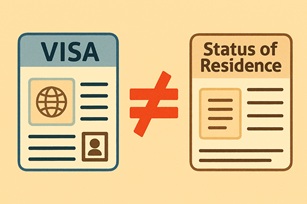
A visa is a permit that allows you to enter Japan. It is issued by a Japanese embassy or consulate abroad. However, it does not grant you permission to work in Japan.
◆What Is a Status of Residence?
A status of residence is the legal qualification that allows a foreign national to stay in Japan for a mid- to long-term period.
It is granted by the Immigration Services Agency under the jurisdiction of the Ministry of Justice. Each status of residence is tied to a specific purpose of stay in Japan—such as marriage to a Japanese national, employment, or other designated activities.
Without a clearly defined purpose, a status of residence cannot be granted.
◆Is a Status of Residence the Same as a Visa?
Strictly speaking, a “status of residence” is different from a visa.
However, the statuses of residence granted according to the purpose of activities in Japan are commonly referred to by nicknames such as “student visa” or “spouse of Japanese national visa.” The activities permitted under each status are defined by law, and in principle, staying in Japan beyond those prescribed activities is not allowed.
◆Is It Difficult to Obtain a Status of Residence?
I believe the difficulty of obtaining a status of residence can be broadly divided into two aspects.
●Institutional Challenges in Residence Status Procedures
Residence status is granted to foreign nationals under the Immigration Control and Refugee Recognition Act (hereinafter referred to as the Immigration Act).
However, since the Act itself does not set out detailed regulations, the decision on whether residence status is approved or denied is left to the discretion of immigration officers.
While officers make their decisions based on certain standards, those standards are not publicly disclosed.
Reasons for non-disclosure may include:
(1) the standards may be adjusted depending on government policy at the time of examination, and
(2) overly clear standards could encourage the submission of falsified evidence.Therefore, applicants must prepare the necessary documents by referring to information available on the Immigration Bureau’s official website and by paying attention to the responses of immigration officers.
●Difficulties in Document-Based Proof
In immigration examinations, all requested matters must be presented in written documents. There is no room for oral explanations, so if a fact cannot be substantiated in writing, even if it is true, it cannot persuade the examiner.
Which documents are effective depends on the applicant’s circumstances, and there is no single “magic document” that will guarantee approval.
◆Who Can Submit a Residence Application in Japan?
The following individuals are eligible to apply for a status of residence in Japan.
1) The Applicant
An applicant who resides outside Japan and does not yet hold a status of residence cannot apply for it directly. However, applications for changing or renewing an existing status of residence can be submitted by the applicant themselves.
2) Legal Representative
A legal representative of the applicant may apply on their behalf. In the case of an international marriage, this typically refers to the applicant’s Japanese spouse.
3) Authorized Attorney or Administrative Scrivener
Even attorneys or administrative scriveners cannot submit the application unless they are officially authorized as immigration application agents.
◆What is a Residence card?
A Residence Card is an identification document issued to foreign nationals who stay in Japan for a medium- to long-term period.
It contains essential information such as the holder’s residence status, address, and period of stay.
The card must be carried at all times, and it must be presented without delay if requested by police officers or immigration officials.
The information recorded on the card must always be kept up to date. In particular, when changing one’s address, the new address must be reported to the municipal office of the new residence within 14 days so that the card can be updated accordingly.
Failure to complete this procedure may result in fines and could negatively affect future applications to renew one’s residence status.
In this sense, the Residence Card is not merely an identification document, but an important legal foundation that ensures foreign residents can continue their lives in Japan with security and peace of mind.
◆Application Agents Can Help with These Procedures
●Obtaining a Status of Residence as a Spouse of a Japanese National (commonly known as Japanese Spouse visa)
This status of residence is intended for foreign nationals who are married to a Japanese citizen or who are the biological child of the Japanese national (commonly known as Japanese Spouse visa).
→Click here for information about the “Spouse and Child of the Japanese national” status of residence (commonly known as Japanese Spouse visa).
●Obtaining a Long-Term Resident Visa (commonly known as the Long-Term Resident visa)
The status of residence “Long-Term Resident” applies to foreign nationals who stay in Japan for various reasons. It is a status that may be granted, for example, to foreign nationals who have divorced a Japanese citizen, or to the children of foreign nationals married to Japanese citizens.
→Click here for information about the “Long-Term Resident” status of residence (commonly known as the Long-Term Resident visa).
●Acquisition of the “Family Stay” Status of Residence (commonly known as the Family Visa)
The status of residence for family members joining someone who is already staying in Japan with a visa.
→Click here for information about the “Dependent” status of residence (commonly known as the family visa).
●Application for Change of Status of Residence
This is the procedure for changing your current visa status to “Spouse or Child of Japanese National” based on your marriage to a Japanese citizen.
→Click here for information about applications to change your status of residence.
●Application for Extension of Period of Stay
To continue staying legally, you must apply to renew your status before it expires. If there are any changes during your period of stay—such as address, employer, or marital status—you are also required to submit a notification to the Immigration Services Agency.
→Click here for information about applications to extend the period of stay (extension of status of residence).
●Obtaining Permanent Resident Status
Once you obtain permanent residency, you will no longer need to renew your status of residence, allowing you to continue your life in Japan with greater stability.
However, permanent residency can only be applied for after you have sufficiently adapted to life in Japan, by changing from another status of residence. Please note that it cannot be obtained immediately upon entering the country.
→Click here to learn more about Permanent Resident status.
●Application for Spouse or Child of Permanent Resident Status
This status of residence is intended for the spouse or biological child of a permanent resident.
It is a status granted in connection with the permanent resident, and although it has a fixed period of validity, it is considered more stable than the “Dependent” status of residence (commonly referred to as a family visa).
→Click here to learn more about the “Permanent Resident” status of residence.
●Naturalization Application Procedure
Applying for Japanese nationality through naturalization is different from status of residence.
The process generally takes over a year, and once it is completed, you gain the rights and responsibilities of a Japanese citizen.
→Click here to learn more about the naturalization application process.
●Re-entry Procedures
If you plan to leave Japan for more than one year after obtaining your residence status, you must apply for a re-entry permit before departure.
→Click here to learn more if you intend to stay outside Japan for over a year.
●Permission to Engage in Activity Other Than That Permitted under the Status of Residence
Those holding the “Dependent” status of residence (commonly called a family visa) are not permitted to work by default. To take up part-time employment, they must obtain permission from the Immigration Services Agency of Japan.
→Click here to learn more about Permission to Engage in Activity Other Than That Permitted under the Status of Residence.
●Other Residence Status Applications
This is guidance on other types of status of residence. The explanations provided are brief, so please contact us directly to confirm which status may apply to you.
→Click here to learn more about other status of residence categories.
●Other Administrative Procedures
If you have questions about your family’s nationality, are unsure about Japanese laws, or have difficulty understanding explanations at city offices when submitting documents, please feel free to consult with me!
→Click here for sample cases of inquiries to government offices outside of status of residence matters.